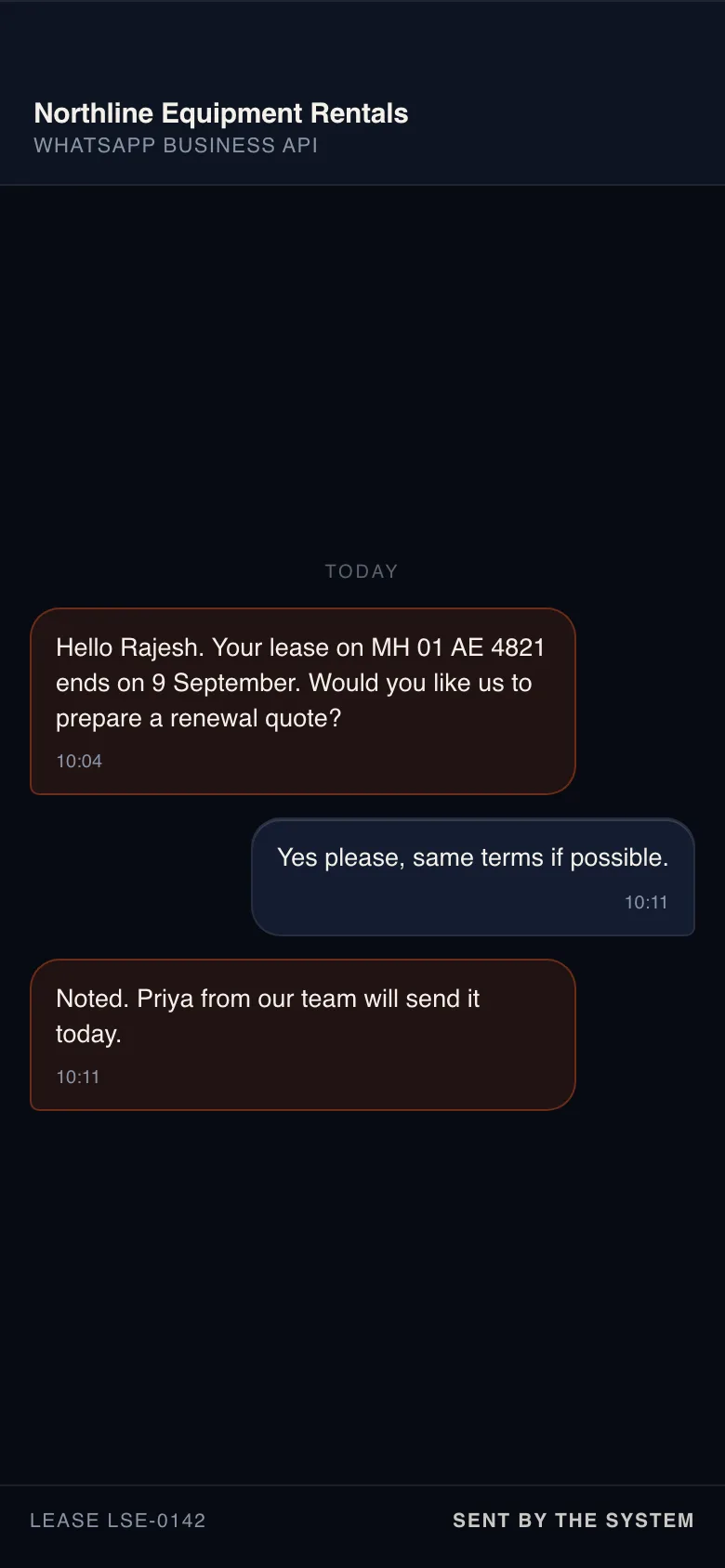
Renewal reminders, delivery updates, document collection and status replies, on the official API.
Automation
Automation that earns its running cost.
Workflow and AI automation for operations: the repetitive steps inside a leasing, rental, fleet or logistics business, automated — and the monthly bill for each one stated in writing first.
What we automate
Five channels. One operation.
Welcome, confirmation, invoice and reminder mails triggered by your system, with no AI where none is needed.
Voice
AI calls for payment reminders, service-due bookings and lead callbacks — consented, logged against the record.
Chat
An assistant that answers from your own data — contracts, fleet, payments — for your team or your customers.
AI agents
Multi-step work: read documents, research, draft, route for review, notify. A person confirms before anything leaves.
Where it pays
Where automation actually pays in an operation.
Most businesses that run vehicles or equipment have the same handful of steps eating hours every week. A renewal is coming up and someone has to remember to call. A document arrives on WhatsApp and someone has to find the file it belongs to. An invoice needs typing into accounts. A lead fills in a form and waits a day for a reply. None of these need a person's judgement — they need a system that notices the trigger and does the next thing. That is what we automate. We don't start from “what can AI do”; we start from your week, and pick the steps where a machine is cheaper, faster and more reliable than a person copying information from one place to another.
The part most people won't tell you
AI automation has a monthly bill.
Software you own runs at the cost of hosting. Anything using an AI model charges per use — every message, every document, every minute — and that cost is yours, not ours. We don't mark it up and we don't hide it. Before building, we work out the running cost at your real volume and compare it with what the step costs you today. Sometimes plain software with no AI does the job for nothing a month. Sometimes the honest answer is that the current way is cheaper. You get that comparison in writing.
How it works
Four steps to a running automation.
Map the step
We watch how it happens today: who does it, how often, what breaks.
Cost it
Build cost, running cost per month at your volume, and what it costs you now. In writing.
Build it
Usually two to four weeks for one channel. You see it working on your real data before it goes live.
Run it
Hosted, monitored and supported under the maintenance contract. Bugs fixed free, forever.
How we decide
How we decide what gets AI and what doesn't.
Two questions settle it. Does the step vary — different documents, different wording, different situations every time? And what does a wrong answer cost? Steps that repeat exactly get plain software: a fixed template, a rule, a scheduled job. No AI, no per-use bill, nothing to check. Steps that vary — reading a supplier's invoice, drafting a reply to an unusual question, researching a company — get an AI model, and a review step wherever a mistake would cost money. Every automation we quote says which of the two it is, and why.
Pricing
Straightforward pricing.
A one-time build, plus a maintenance contract that keeps it running.
Every automation is scoped in a free discovery call and quoted at a fixed price in writing. The quote has three lines: the build, the monthly maintenance (hosting, monitoring, updates, support), and the running cost of the AI and messaging at your volume — passed through at cost, never marked up. Single-channel automations are usually live in two to four weeks.
Every quote states the monthly running cost. No exceptions.
Proof
Built, running, and honest about what it costs.
Case study
Find, research, draft — a person sends.
A multi-agent pipeline built for a digital marketing agency.
FAQ
Often normal software is the better answer: no per-use cost, predictable, nothing to check. AI earns its cost where the work involves reading varied documents, drafting text, or handling variation rules can't cover. We tell you which applies.
It depends on volume and what the automation does. A step running a few hundred times a month costs very little; one running constantly across large documents costs more. We work out the figure at your volume and give it to you in writing before you commit.
Worth it: steps that happen often, follow a pattern, and currently eat real hours — document handling, data entry, routine follow-ups. Not worth it: anything infrequent, anything where a mistake is expensive, and anything plain software solves with no ongoing cost.
Usually two to four weeks for one channel — say, WhatsApp reminders connected to your contract records. Agents that read documents and connect to several systems take longer. You see it working on your real data before it goes live.
For anything beyond simple reminders, yes: an automation is only as good as the record it reads from. If your data lives in spreadsheets, we start by putting a system under it — that is what Solvern builds.
You do. Code, prompts, data and accounts are in your name. No lock-in.
It keeps running. The code, prompts, accounts and data are yours, documented so another developer can maintain them. The maintenance contract is for convenience, not a lock.
Anything that matters goes to a person before it leaves. We design the review step in, not around.
Have a workflow that's breaking? Let's look at it together.
Free discovery — we sit with your team and map how the work actually happens today. No charge, no obligation.
Or directly: +91 99874 29712 · hello@solvern.in